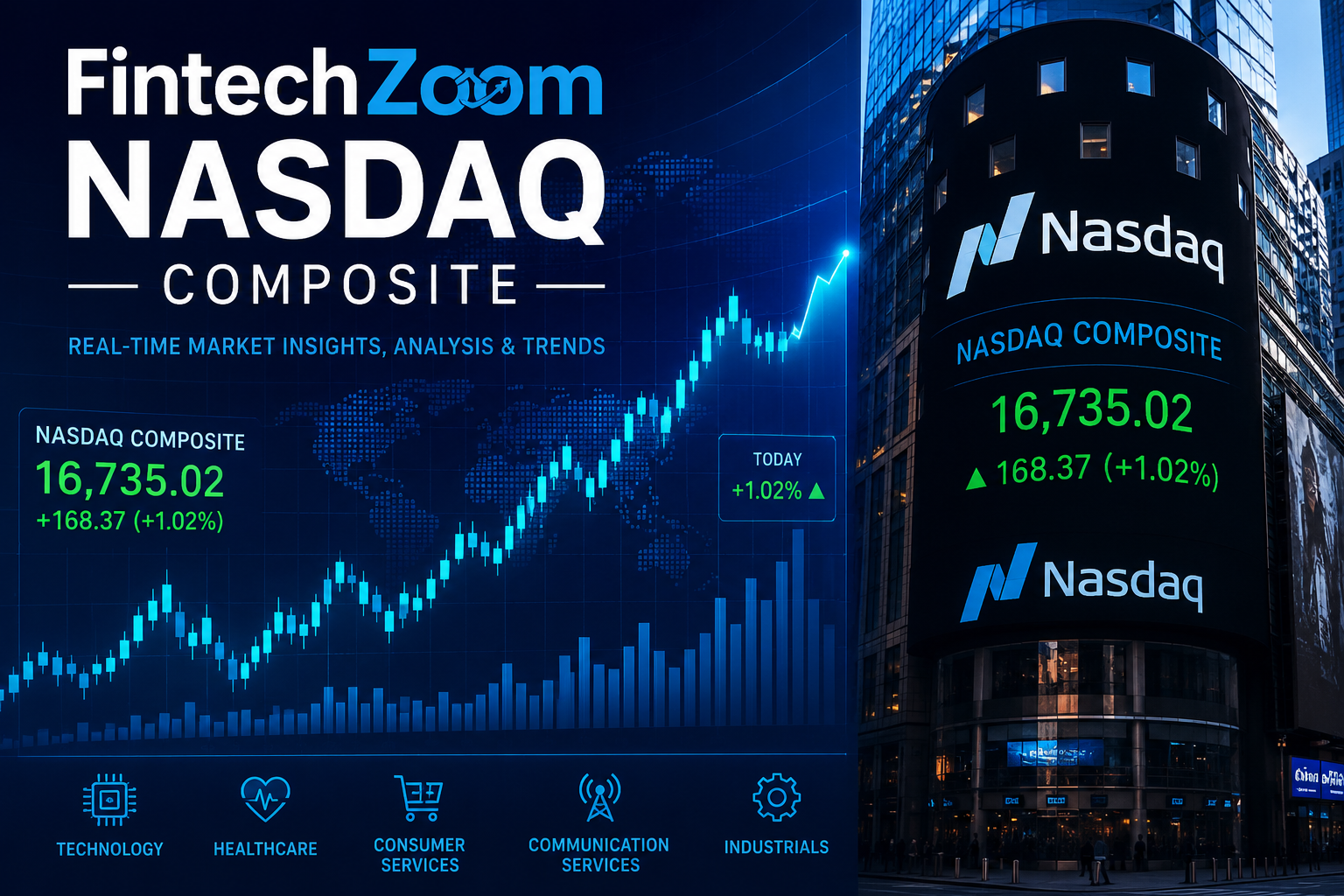
The NASDAQ Composite remains one of the most closely watched stock market indexes in the world. Investors often rely on FintechZoom NASDAQ Composite coverage to understand market trends, technology sector performance, and investment opportunities.
Because the index contains thousands of companies, it offers a broad view of innovation-driven businesses and overall market sentiment. Understanding its movements can help investors make more informed decisions.
Quick Bio
| Feature | Details |
|---|---|
| Keyword | FintechZoom NASDAQ Composite |
| Core Definition | Analysis, news, and market insights related to the NASDAQ Composite Index |
| Origin | NASDAQ Composite launched in 1971 alongside the NASDAQ exchange |
| Primary Use | Tracking performance of NASDAQ-listed companies |
| Industry | Financial Markets, Investing, Fintech |
| Common Components | Technology, Healthcare, Consumer Services, Telecommunications |
| Popular Applications | Market Analysis, Portfolio Management, Investment Research |
| Exchange | NASDAQ Stock Market |
| Number of Listed Companies | More than 3,000 |
| Weighting Method | Market Capitalization Weighted |
| Key Focus Area | Growth and Technology Stocks |
What Is FintechZoom NASDAQ Composite?
FintechZoom dives into the NASDAQ Composite, breaking down its shifts through reports and forward looks. When tracking how tech-heavy stocks react, many turn to these updates instead of generic summaries. Movement here often hints at broader financial currents. Insights appear alongside real-time reactions, shaping how people interpret jumps or dips.
Thousands of firms traded on the NASDAQ feed into its composite index, turning it into a wide-reaching measure. One of the most expansive yardsticks out there comes from how many stocks get pulled in.
Understanding the NASDAQ Composite Index
The NASDAQ Composite Index includes companies from multiple sectors, although technology firms represent a significant portion of its total value.
Unlike narrower indexes, it provides exposure to both large-cap leaders and smaller growth-oriented businesses.
Why Investors Watch the Index
Investors view the NASDAQ Composite as a measure of innovation-driven economic growth. Many of the world’s largest technology companies are part of this benchmark.
Changes in the index often reflect broader shifts in investor confidence and economic expectations.
Historical Background of NASDAQ Composite
The NASDAQ Composite was introduced in 1971 when the NASDAQ exchange became operational. Initially, it served as a way to measure the performance of electronically traded securities.
Over the decades, the index evolved into a global benchmark for technology and growth stocks.
The Dot-Com Boom and Recovery
During the late 1990s, technology enthusiasm pushed the index to unprecedented levels. The subsequent dot-com crash highlighted the risks of speculative investing.
Recovery took years, but stronger business fundamentals eventually restored investor confidence.
How FintechZoom NASDAQ Composite Analysis Helps Investors
Market participants seek FintechZoom NASDAQ Composite coverage because it combines news, data interpretation, and trend analysis.
These insights can help investors understand earnings reports, interest rate changes, and macroeconomic developments affecting the market.
Key Areas Covered
- Market trends
- Earnings updates
- Economic indicators
- Technology sector developments
- Investment opportunities
Major Sectors Driving NASDAQ Performance
Technology remains the dominant sector within the NASDAQ Composite, but several other industries contribute significantly.
Healthcare, consumer services, industrial technology, and communication services all influence index performance.
Technology’s Influence
Technology companies often account for more than half of the index’s total market value. This concentration makes innovation cycles particularly important.
Advances in artificial intelligence, cloud computing, and cybersecurity frequently impact index direction.
Factors That Influence NASDAQ Composite Movements
Several variables affect daily and long-term index performance.
Interest rates, corporate earnings, inflation data, and geopolitical events are among the most significant drivers.
Economic Indicators to Monitor
Investors commonly track:
- Inflation reports
- Employment data
- GDP growth
- Federal Reserve decisions
- Consumer spending trends
These indicators can create substantial market volatility.
FintechZoom NASDAQ Composite and Technology Stocks
Technology stocks often serve as the primary engine behind index growth.
Companies involved in software, semiconductors, digital platforms, and artificial intelligence frequently shape overall market performance.
Growth vs. Value Dynamics
Growth-oriented technology companies tend to outperform during periods of economic expansion.
Conversely, rising interest rates can pressure valuations and lead investors toward value-focused investments.
Investment Strategies Based on NASDAQ Trends
Many investors use FintechZoom NASDAQ Composite research to build strategic investment plans.
Different approaches suit different risk profiles and financial objectives.
Common Investment Approaches
Long-Term Investing
Long-term investors focus on market growth over years rather than short-term fluctuations.
Dollar-Cost Averaging
Regular investments can reduce the impact of market volatility.
Sector Rotation
Some investors shift capital between sectors based on economic conditions and market cycles.
Benefits of Following FintechZoom NASDAQ Composite Updates
Timely market information can improve decision-making.
Investors gain access to earnings analysis, economic interpretations, and expert perspectives that help identify opportunities and risks.
Advantages for Different Investors
- Beginners gain market education.
- Active traders receive timely insights.
- Long-term investors monitor macro trends.
- Portfolio managers evaluate sector performance.
Risks Associated with NASDAQ Investing
Despite strong historical growth, investing in NASDAQ-listed companies carries risks.
Market corrections, economic slowdowns, and valuation concerns can lead to significant price declines.
Volatility Considerations
Technology-heavy indexes often experience larger price swings than broader market benchmarks.
Investors should maintain diversified portfolios to manage risk effectively.
Comparing NASDAQ Composite With Other Indexes
The NASDAQ Composite differs from other major indexes due to its heavy technology weighting.
This distinction creates unique opportunities and challenges.
| Index | Primary Focus | Number of Companies |
|---|---|---|
| NASDAQ Composite | Broad NASDAQ Market | 3,000+ |
| S&P 500 | Large U.S. Companies | 500 |
| Dow Jones Industrial Average | Blue-Chip Stocks | 30 |
| Russell 2000 | Small-Cap Companies | 2,000 |
Global Impact of NASDAQ Composite Performance
Movements in the NASDAQ Composite influence financial markets worldwide.
International investors often view the index as a gauge of innovation, business confidence, and economic momentum.
Cross-Market Effects
Strong NASDAQ performance can improve sentiment across global stock exchanges, while sharp declines may trigger broader market caution.
Future Trends Shaping NASDAQ Growth
Emerging technologies continue to transform the investment landscape.
Artificial intelligence, automation, renewable energy solutions, biotechnology, and advanced computing may drive future index growth.
Areas to Watch
- Artificial Intelligence
- Quantum Computing
- Green Technology
- Biotechnology
- Digital Infrastructure
These industries could become major contributors to future market expansion.
The Role of Data Analytics in Market Forecasting
Advanced analytics tools allow investors to identify patterns and trends more effectively.
Many analysts use predictive models, historical data, and machine learning techniques to evaluate potential market movements.
Why Analytics Matter
Better data interpretation can improve risk management and investment decision-making.
However, no forecasting model guarantees future performance.
Conclusion
Right now, FintechZoom covers the NASDAQ Composite in a way that makes complex data easier to grasp. Because it tracks shifts across tech sectors, readers spot patterns before they peak. When interest rates shift or jobs reports land, the index often reacts fast – this coverage keeps pace. Even if you just started looking at stocks, seeing how components move together builds confidence. For those who have watched markets longer, the details offer sharper context than headlines ever do. Behind every jump or dip, there is usually a clue hiding in earnings or policy changes – and this platform pulls them out. With time, using these updates becomes less about chasing news and more about spotting signals early.
FAQs
1. What is FintechZoom NASDAQ Composite?
FintechZoom NASDAQ Composite refers to market analysis, news coverage, forecasts, and insights related to the NASDAQ Composite Index, helping investors understand market performance and trends.
2. Why is the NASDAQ Composite important for investors?
The NASDAQ Composite tracks more than 3,000 listed companies and serves as a key indicator of technology sector strength, innovation, and overall market sentiment.
3. Which sectors have the biggest influence on the NASDAQ Composite?
Technology is the largest contributor, followed by healthcare, communication services, consumer discretionary businesses, and various growth-oriented industries.
4. How does inflation affect the NASDAQ Composite?
Higher inflation can lead to increased interest rates, which may reduce growth stock valuations and create volatility within the NASDAQ Composite.
5. Can beginners use FintechZoom NASDAQ Composite insights for investing?
Yes. Beginners can use market analysis, trend reports, and educational content related to the NASDAQ Composite to better understand investment opportunities and risks before making financial decisions.
Disclaimer
The information provided in this article about FintechZoom NASDAQ Composite is for educational and informational purposes only. It should not be considered financial, investment, legal, or professional advice. While every effort has been made to ensure the accuracy of the content, stock market conditions, index values, and financial data can change rapidly.
Investing in the NASDAQ Composite or any financial market involves risk, including the potential loss of capital. Past performance does not guarantee future results. Readers should conduct their own research and consult a qualified financial advisor before making any investment decisions.
References to FintechZoom NASDAQ Composite, market trends, forecasts, or investment strategies are intended solely to provide general market insights and should not be interpreted as recommendations to buy, sell, or hold any security. The author and publisher assume no responsibility for financial losses or decisions made based on the information presented in this article.